
Generic Induction
1.1 Overview
Welcome to our construction site, This site induction aims to foster a robust health and safety culture, promote environmental awareness, and achieve quality objectives throughout our construction projects. It adheres strictly to the Safety (WHS) laws, Codes of Practice, and industry guidelines and aligns with the stakeholders, public, council and clients of each project.
The scope of work encompasses various activities but not limited to Clearing, bulk earthworks, road construction, drainage systems, concrete work, sediment controls, and operations in environmentally sensitive areas.
Your diligence and commitment are the cornerstones of the projects success. As we embark on these multifaceted construction endeavors, your active participation and adherence to the health, safety, and environmental protocols are crucial. We invite each of you to be an integral part of this shared journey, ensuring that every task, from start to completion, are performed with excellence. Your cooperation is not only valued but essential, as we work together to uphold the standards that define us. Let us collaborate to create not only structures but also a legacy of safety, quality, and environmental stewardship.
2.0 Housekeeping & Emergency Procedures
2.1 Site Map & Emergency Procedures
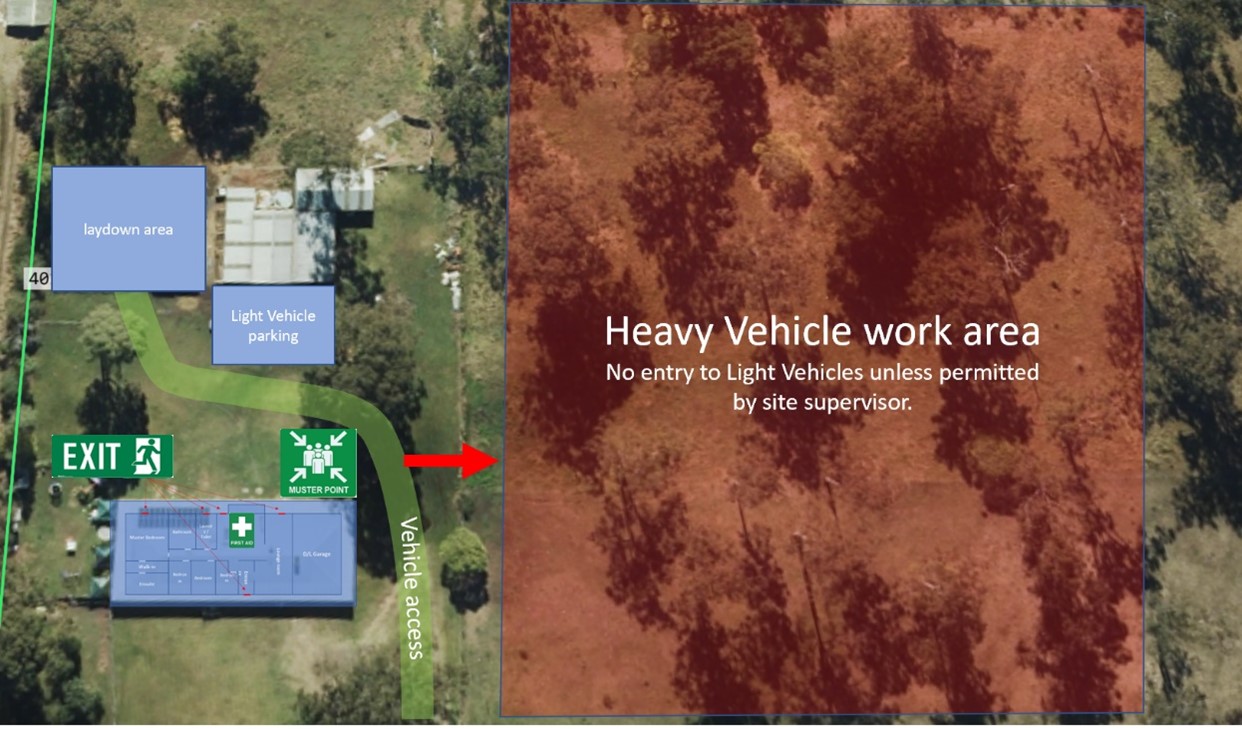
Upon arrival at the site, individuals will receive a comprehensive site map outlining emergency procedures and the designated muster point.
In the event of a life-threatening emergency and you are unable to immediately notify your site supervisor, Emergency services are to be contact immediately and directed to the site address noted on your site map, An inducted employee is to remain at the entrance in preparation to escort emergency service to the event location.
All heavy equipment is to be parked in a safe location, with personnel to remain by radio communication for further instruction.
Example of site map and emergency contact
Emergency Services: Phone: 000
Site Supervisor / Contact: Supervisor – 0412 345 678
Address: Unknown lane, Unknown QLd 4220
2.2 Site Amenities and Access
Site amenities, such as first aid kits, fire extinguishers, and waste disposal facilities, will be conveniently located at the on-site office and lunchroom or in close proximity as indicated on the site map. Access to the site is restricted to authorized personnel to ensure a secure and safe working environment.
2.3 Incident Reporting and Complaints
All events including but not limited to Environmental spills or harm, Injury, damage, theft, vandalism, near misses (nearly an event), trespassing, bullying, disrespectful behaviours or content are to be reported directly and immediately to your site supervisor reporting, recording or resolution.
The reporting process is important in establishing and maintaining a positive safety environment and work culture, quality outcomes and continuous improvement to processes.
Communication or questions from the local community are to be directed to the site supervisor.
2.4 Deliveries and Material Handling
All delivery and material handling processes must adhere to safety standards and procedures. Proper certification and verification of competency are mandatory for the operation of unloading equipment. Safe work practices must be observed to mitigate risks during these activities.
2.5 Visitor Management
All visitors to the site must report to the site office or supervisor to undergo a site induction and or be accompanied by an inducted site escort throughout their visit to ensure their safety and compliance with site regulations.
2.6 Parking Facilities
Designated parking areas for employees and visitors will be clearly marked and regularly monitored to ensure safety and efficient traffic management on-site.
2.7 Evacuation Routes
Evacuation plans, including muster points and escape routes, will be prominently displayed in the site office and on your site map. Any changes to the evacuation plan will be promptly communicated to all workers through toolbox talks.
3.0 Health, Safety & Environmental Procedures
3.1 Operation of Plant and Equipment
All personnel operating plant and equipment must possess valid OH&S or RII competency licenses. All equipment must be fitted with Safety measures, such as flashing lights and UHF radios and reverse alarm, must be implemented and operational at all times during equipment use.
Positive communication is required for all plant, equipment and personnel entering with 20m of operational plant or equipment.
Heavy vehicle operational areas are restricted to the light vehicles and personnel, access will only be granted to the immediate work force required to work in the area, for access to other non-earthworks areas and activities such as concrete and electrical installation a “Traffic management plan” TMP is to be implemented with the main consideration to be separation between heavy vehicle and light vehicle access roads, where heavy vehicle and light vehicle roads are required to intersect signage and traffic control measures are to be implemented and documented on the TMP.
3.2 SWMS and Risk Management
Comprehensive risk assessments must be conducted for high-risk activities, with Safe Work Method Statements (SWMS) or Job Safety Analysis (JSA) readily available at the work front to address potential hazards and ensure safe work practices. If contracting and operating your own supplied equipment, a SWMS must be provided and approved for use by the site supervisor. For any items of work that have identified potential risk and or potential harm to workers a Risk assessment must be completed by means of SWMS or JSA.
3.3 Environmental Controls
Sediment and erosion controls are to be installed and maintained around the works area, any damage to these controls are to be remedied immediately and or reported to your site supervisor. The engineering plans for the development include Erosion and Sediment Control Plans and Details and can be referred to.
3.4 Air and Dust Management
Efficient dust control measures must be implemented and regularly monitored, with proper communication and coordination with water trucks for effective dust suppression as required.
3.5 Noise and Vibration Controls
Noise and vibration impacts on local residents must be minimized during construction activities through proper planning and mitigation strategies to ensure compliance with environmental regulations.
3.6 Waste Management
Waste management practices must comply with the Environmental Protection (Interim Waste) Regulation 1996 and follow a waste hierarchy approach – avoid, reuse, reduce, recycle, treat, and dispose. Proper segregation, collection, and disposal of waste materials must be carried out in accordance with approved waste management procedures.
3.7 Working Hours
Construction activities are permitted between 6:30 am to 6:30 pm, Monday to Saturday, with no work on Sundays or public holidays unless specifically authorized. Plant and equipment operations are restricted to these designated hours to minimize disruption and ensure compliance with legal requirements.
Kindly review the content to ensure alignment with the specific WHS requirements and regulations applicable to your construction projects.